Get Your Free Quote…!


Compact articulating boom for lifting into tight, obstructed spaces.
View Details →

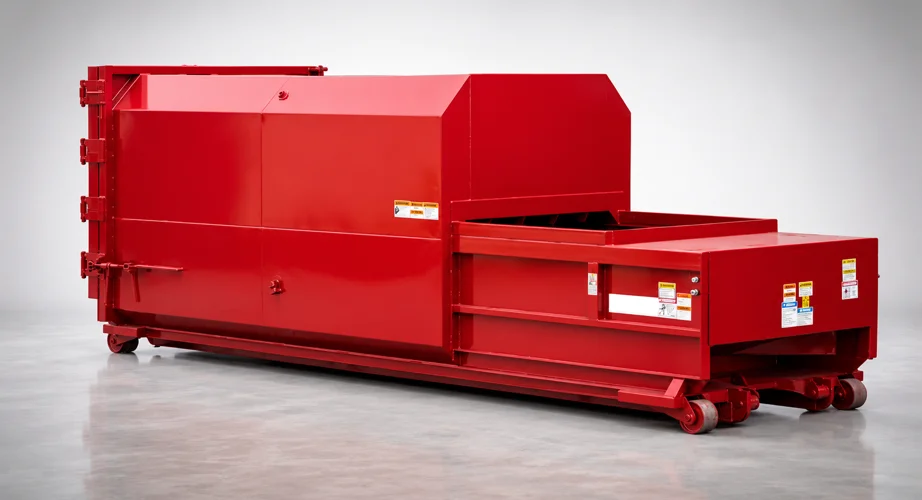
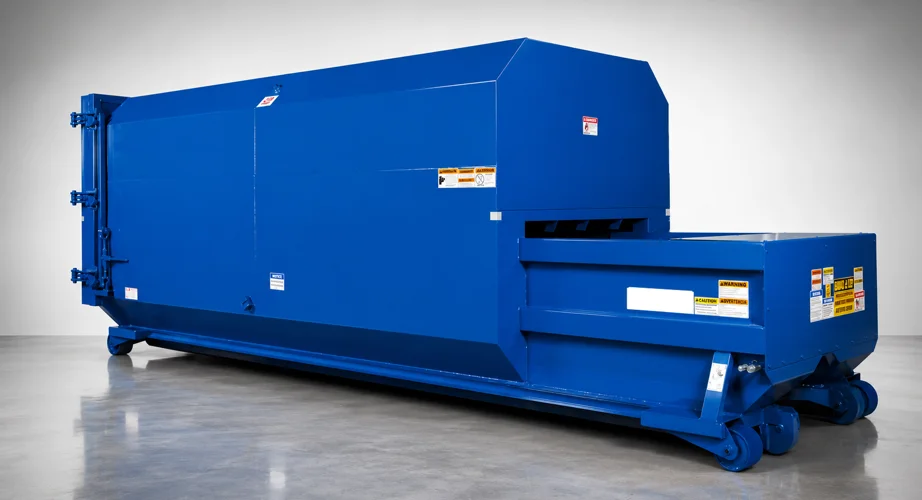
Our stationary compactor is a fixed installation — typically mounted on a concrete pad at a loading dock or waste collection point — that compresses dry waste before it ever leaves the site, cutting down on both the volume hauled away and the number of trips a hauler needs to make. Unlike a mobile compactor truck, it stays in place and is paired with a separate roll-off container that the hauler swaps out once full.
Page last updated: September 10, 2026
Waste is loaded into the compaction chamber — manually, by cart, or via a conveyor feeding directly from a production or packing line. A hydraulically driven ram then pushes the material through the chamber and into the attached container, compressing it against material already loaded. For dry waste like corrugated cardboard, mixed paper, stretch film, and plastics, this typically achieves a compaction ratio in the range of 3:1 to 4:1 — meaning roughly three to four cubic yards of loose material is reduced to about one cubic yard once compacted, directly cutting the number of container pulls (and the associated hauling cost) a site needs.
A stationary compactor is a fixed installation at the waste site itself, paired with a separate roll-off container the hauler swaps out once full — it doesn't drive anywhere. A compactor truck is a mobile vehicle that collects and compacts waste along a route.
For dry waste such as cardboard, paper, and plastics, a compaction ratio in the 3:1 to 4:1 range is typical, meaning three to four cubic yards of loose material compacts down to about one cubic yard.
Depending on the configuration, waste can be loaded manually, by cart, or fed automatically by a conveyor from a production or packing line.
Municipal waste transfer centers, retail distribution centers, manufacturing plants and warehouses, and other high-volume sites such as hospitals and department stores.