Get Your Free Quote…!


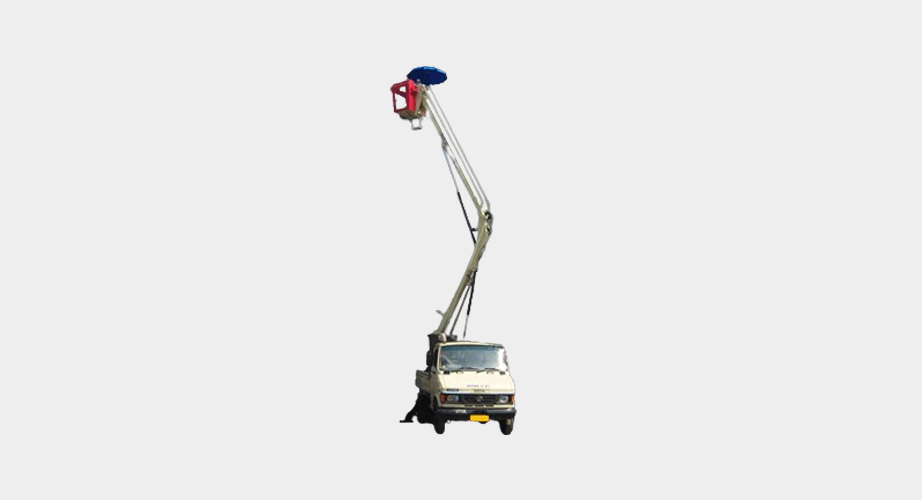
Compact articulating boom for lifting into tight, obstructed spaces.
View Details →

An articulating boom lift bends at hinged joints, so the bucket can travel up, over, and around obstacles. A telescopic boom lift extends in a straight line, giving the most height and horizontal outreach. Choose articulating for obstructed work; choose telescopic for tall, open-access jobs.
Most comparisons online focus on self-propelled lifts that drive around a job site. This guide is about truck mounted boom lifts, also called bucket trucks, cherry pickers, man lifts, hydraulic access platforms, or aerial work platforms. These are the lifts city crews, utilities, and contractors use to reach street lights, high mast lighting, power lines, signs, trees, building facades, and metro and transit construction work from the road.
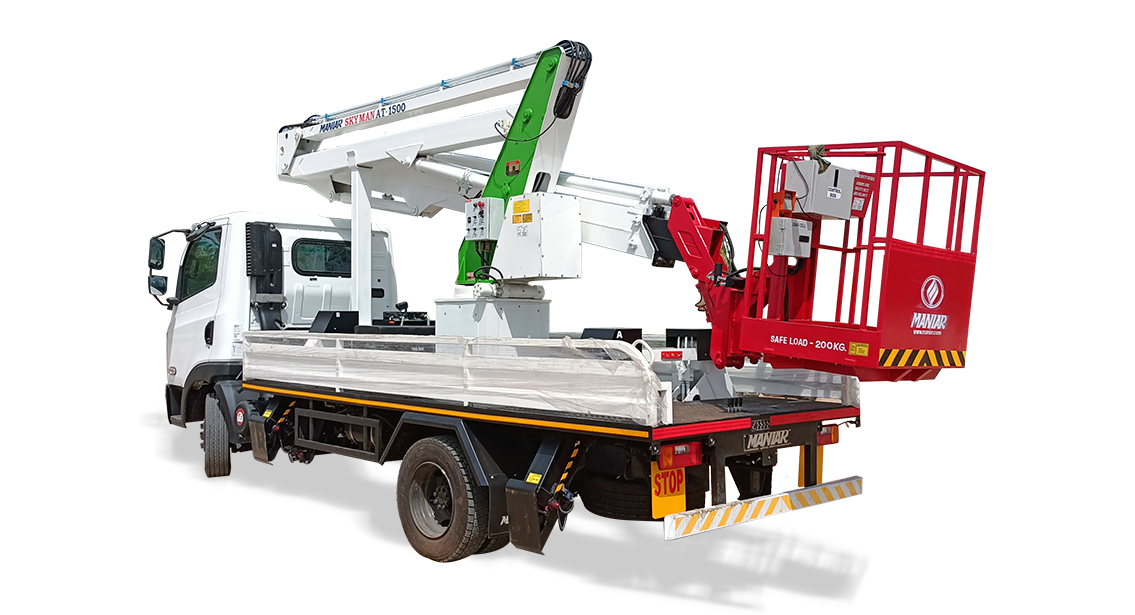
An articulating boom lift, sometimes called a knuckle boom lift, uses two or more boom sections connected by hinges. Each section moves on its own hydraulic cylinder.
The operator raises the lower boom, then angles the upper boom to bring the bucket up and over an obstacle. The bucket can then drop down on the far side, close to the work. This "up and over" motion is what sets articulating lifts apart.
On a truck mounted unit, outriggers level and stabilize the truck before the boom rises. When the job is done, the boom folds back down onto the truck body for travel.
Articulating lifts usually offer less maximum height and horizontal outreach than telescopic lifts of a similar size. For very tall poles or long reaches across open space, a telescopic boom is often the better tool.
Maniar's truck mounted articulating boom lifts offer 33 to 51 feet of working height.
A telescopic boom lift, also called a straight boom lift, has a single boom made of nested sections that slide out in a straight line.
The boom raises to the needed angle, then extends to push the bucket up and out. Because the boom stays straight, the bucket follows a direct path to the work.
A telescopic boom cannot bend around an obstacle. If a tree, wire, or roof edge sits between the truck and the work, the operator may need to reposition the truck or choose another lift.
Maniar's truck mounted telescopic boom lifts offer 49 to 98 feet of working height.
An articulating telescopic boom lift combines both designs. It has a hinged, articulating boom with a telescoping section added.
The result is up-and-over access plus extra height and outreach. Crews that handle many different jobs from one truck often choose this type, because it covers both obstructed work and taller lifts.
Maniar's articulating telescopic boom lifts offer 43 to 95 feet of working height.
See the full range of truck mounted aerial work platforms.
The main trade-off is flexibility versus height: articulating lifts work around obstacles, while telescopic lifts reach higher and farther in open space.
| Feature | Articulating | Articulating Telescopic | Telescopic |
|---|---|---|---|
| Boom design | Hinged sections | Hinged sections plus a telescoping section | One straight, telescoping boom |
| Reaches over obstacles | Yes | Yes | No |
| Maximum height | Lower | Medium to high | Highest |
| Horizontal outreach | Shorter | Medium to long | Longest |
| Maniar working height | 33 to 51 ft | 43 to 95 ft | 49 to 98 ft |
| Best for | Trees, wires, tight streets | Mixed jobs from one truck | Tall poles, facades, long reach |
For work near energized lines, the bucket itself matters as much as the boom type. Ask whether an insulated bucket is available and what voltage it is rated for. Maniar offers insulated buckets rated up to 33 kV for electrical maintenance work. Always follow your utility's safety rules for working near energized equipment.
Working height is the height a person in the bucket can reach, which is about the platform height plus the reach of a standing worker. Start with the tallest object you work on regularly, then add room to reach comfortably and to angle around obstacles.
| Typical job | Suggested working height | Lift type to consider |
|---|---|---|
| Residential street lights, signs, low tree work | About 33 to 45 ft | Articulating |
| Arterial street lighting, mid-height tree work | About 45 to 60 ft | Articulating telescopic or telescopic |
| Tall poles, building facades, larger trees | About 60 to 80 ft | Articulating telescopic or telescopic |
| High mast and highway lighting, stadiums, very tall structures | About 80 to 98 ft | Telescopic |
These ranges are general guides. Always confirm the height of your actual assets before you choose a model.
An articulating boom lift bends at hinged joints to reach up, over, and around obstacles. A telescopic boom lift extends in a straight line for more height and horizontal outreach.
A bucket truck is a truck with a boom lift and a work platform, or bucket, mounted on it. It is also called a truck mounted boom lift, man lift, or aerial work platform.
The same machine goes by many names: bucket truck, boom lift, man lift, cherry picker, aerial lift, aerial work platform, and hydraulic access platform. All describe a boom with a work platform that lifts workers to height.
An articulating boom lift, because its hinged boom can reach over branches, wires, and parked vehicles and then drop into the tree canopy.
A telescopic boom lift. In Maniar's range, telescopic models reach up to 98 feet of working height.
It is a hybrid that combines a hinged articulating boom with a telescoping section. It offers up-and-over access plus extra height and outreach.
It depends on the lift's height and weight. Smaller articulating lifts can fit compact trucks, while the tallest telescopic lifts need heavier chassis. Share your truck details to confirm the right fit.
Yes. Maniar offers insulated buckets rated up to 33 kV for electrical maintenance work.
Maniar builds truck mounted articulating, articulating telescopic, and telescopic boom lifts from 33 to 98 feet of working height. Our US team in Windsor, California, can help you match the lift to your jobs and your fleet.
Tell us the height of your tallest regular work, what sits between the truck and the work, and your preferred chassis. We will recommend a model and send specifications.