Get Your Free Quote…!


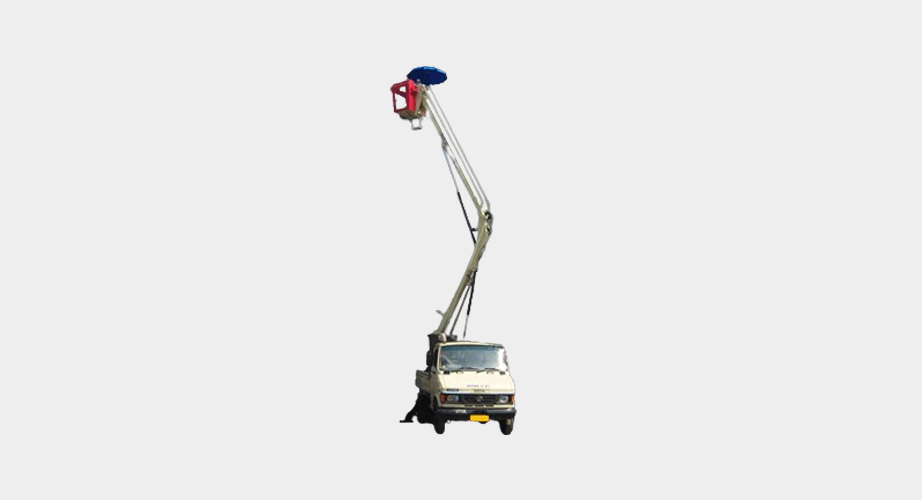
Compact articulating boom for lifting into tight, obstructed spaces.
View Details →

A knuckle boom crane folds at a joint, so it can reach over obstacles and tuck away compactly behind the cab. A straight boom crane extends in one straight line, giving long reach, high lifts, and continuous 360-degree rotation. Both are truck mounted cranes, but they suit different jobs.
Picking the wrong one costs time on every lift. A crew delivering pallets to tight urban job sites may struggle with a long straight boom. A crew setting tall light fixtures may find a knuckle boom runs out of height. This guide compares the two designs and helps you match the crane to your work.
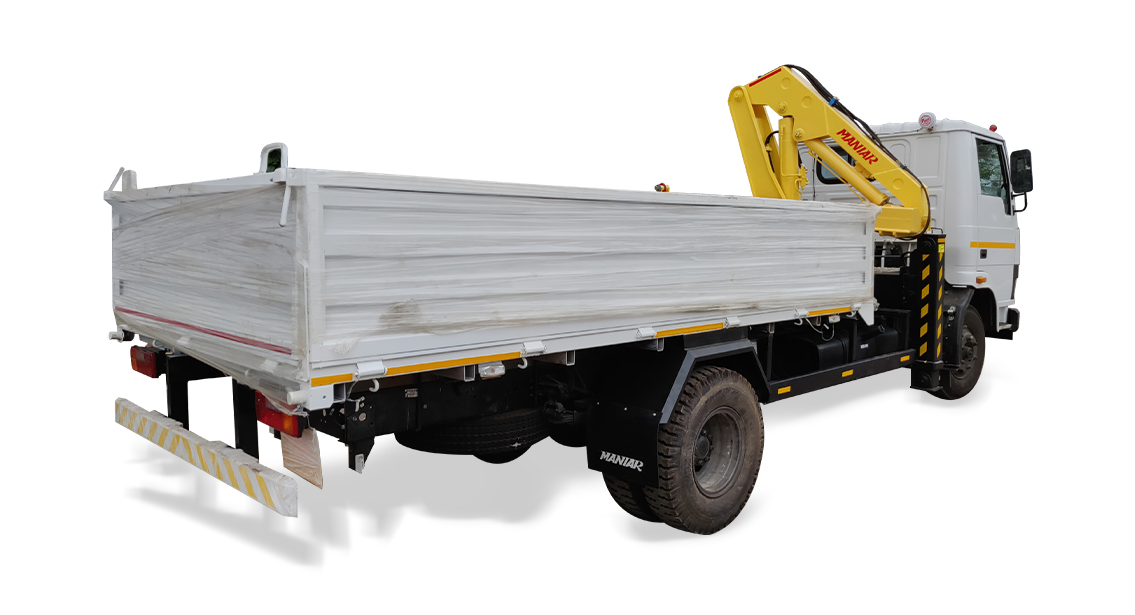
A knuckle boom crane, also called an articulating crane or knuckle crane, is a hydraulic crane with a boom that bends at a hinge, or "knuckle", much like a human finger.
The crane has an inner boom and an outer boom joined by a hinge, plus telescopic extensions on the outer boom. Separate hydraulic cylinders move each section. The operator can raise the inner boom, angle the outer boom down over a wall, and extend it into a tight space, all in one smooth motion.
Loads hang from a hook attached directly to the boom tip; knuckle boom cranes normally work without a winch. Maniar knuckle boom cranes slew through 410 degrees, more than a full circle. Outriggers stabilize the truck during the lift. When the job is done, the boom folds back on itself into a compact package, usually mounted behind the cab.
Because a knuckle boom lifts on a direct hook rather than a winch, it is less suited to lowering a load far below the boom, such as deep into an excavation. For very tall straight-up lifts, a straight boom often reaches higher.
See our truck mounted knuckle boom crane.
A straight boom crane, also called a telescopic boom crane or stiff boom crane, uses a single boom that extends in sections along one straight line. When it is mounted on a truck, the whole unit is often called a boom truck.
The boom raises from its pivot point and telescopes outward to reach the load. Straight boom cranes lift with a hydraulic winch and hook, so the load travels straight up and straight down. Direct hook lifting from the boom tip, as used on knuckle booms, is not practical on a straight boom. The crane turns on a turret and rotates continuously through 360 degrees.
At rest, the boom lies along the length of the truck rather than folding behind the cab.
Because the boom is stowed along the length of the truck, it occupies the truck bed. There is no space to load materials and carry them to another site, as you can with a knuckle boom truck. A straight boom also cannot bend over an obstacle and then drop down behind it.
See our truck mounted straight boom crane.
The core difference is shape: a knuckle boom bends to work around obstacles, while a straight boom extends in a line for height and reach.
| Feature | Knuckle Boom Crane | Straight Boom Crane |
|---|---|---|
| Boom design | Two sections joined by a hinge, plus extensions | One telescoping boom |
| Stowed position | Folds compactly behind the cab | Lies along the length of the truck |
| Reaching over obstacles | Excellent; can reach over, then down | Limited to a straight line |
| Rotation | 410 degrees (Maniar models) | Continuous 360 degrees |
| Lifting method | Direct hook on the boom tip, no winch | Winch and hook; direct hook lifting not used |
| Can carry materials on the truck | Yes, the crane folds behind the cab | No, the boom occupies the truck bed |
| Best for | Delivery, tight sites, precise placement | High lifts, long straight reach, vertical placement |
A knuckle boom is the better fit when the crane is part of a delivery or service truck that must also carry a payload.
A straight boom is the better fit when the lift is mostly about height, distance, and controlled vertical movement.
Some fleets run both: knuckle booms on delivery and service trucks, and straight boom trucks for dedicated lifting work.
The right crane type is only half the decision. Size matters just as much, because an undersized crane limits every job and an oversized one adds cost and weight you do not need. Work through these questions before you request quotes.
Before you buy, check that operators are trained and certified for the crane class and your state's requirements. Ask the manufacturer about operator training and service support as part of the quote.
A knuckle boom bends at a hinge, so it folds compactly and can reach over obstacles. A straight boom extends in one line, rotates continuously through 360 degrees, and lifts with a winch, which suits high lifts and long straight reach.
Yes. Stiff boom, straight boom, and telescopic boom crane are common names for the same design. When the crane is mounted on a truck, the unit is often called a boom truck.
Yes. Articulating crane, knuckle crane, and knuckle boom crane all describe a crane whose boom bends at a joint.
A knuckle boom. It folds behind the cab, leaving the deck free for cargo (a straight boom occupies the truck bed), and it can place loads over fences and walls at the drop point.
For straight vertical lifts, a straight boom crane often reaches higher than a knuckle boom of similar size. A knuckle boom trades some height for flexibility around obstacles.
Normally, no. A knuckle boom crane lifts on a hook attached directly to the boom tip. A straight boom crane lifts with a winch and hook, and direct hook lifting is not practical on a straight boom.
Maniar straight boom cranes rotate continuously through 360 degrees. Maniar knuckle boom cranes slew through 410 degrees, more than a full circle.
Often, yes. It depends on the truck's chassis capacity, frame, and wheelbase. Share your truck details with the manufacturer to confirm the right crane size.
Maniar builds truck mounted knuckle boom and straight boom cranes for utilities, contractors, and municipal fleets. Our US team in Windsor, California, can help you compare designs and sizes for your work.
Tell us your heaviest load, the reach and height you need, and your truck details. We will recommend a crane and send specifications.